
ThiRU AI Data Centre
A federated network of low-cost, small-footprint data centres
Compute and storage that sit close to the people who use them: in metro hubs, on cell towers, in villages and in homes. Every node is federated, data moves between them with a seamless handoff, and the whole network is watched by ThiRU's data-integrity and SOC teams.
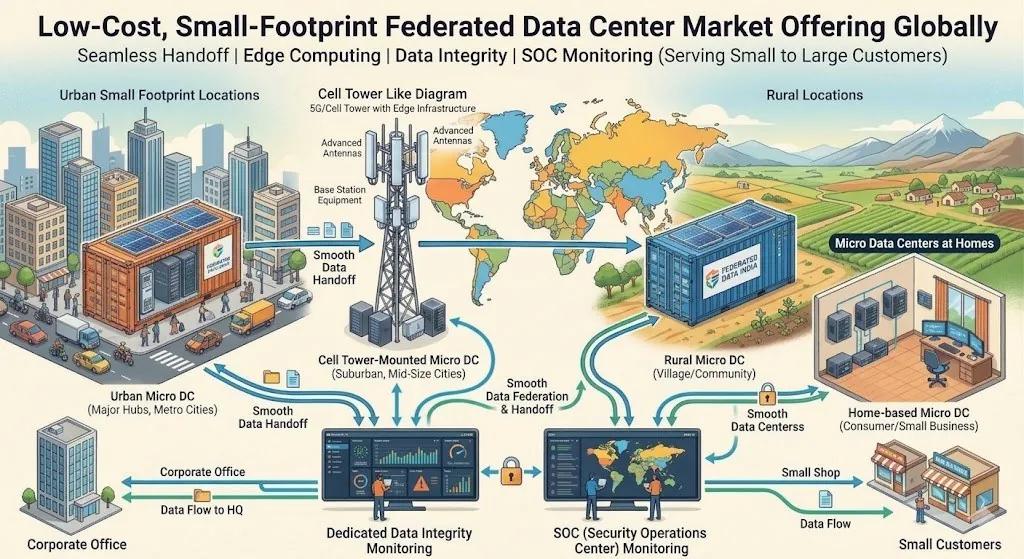
Five node types, one network
Pick the footprint that fits the site
Nodes scale from a single half-height cabinet to a 2 MW solar campus. Choose a node type to see what's inside.
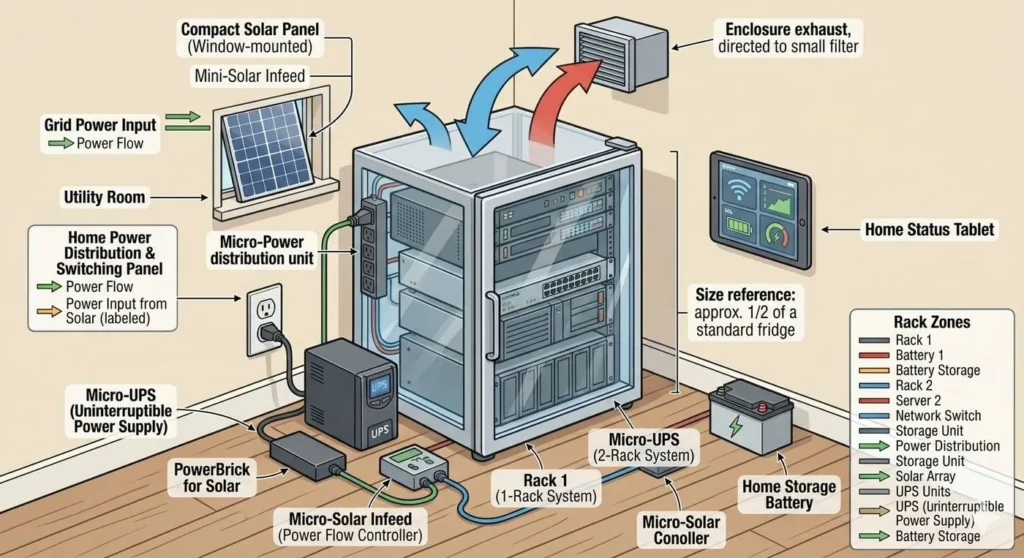
Plug-in micro DC for a home or shop
A sealed glass-front enclosure about half the height of a fridge. It runs from a normal wall socket with a window-mounted solar panel and a home battery, and reports to a wall tablet.
- Footprint
- ≈ ½ standard fridge
- Racks
- 1 (compact)
- Power
- Grid + window solar + home battery
- Resilience
- Micro-UPS, micro-PDU
- Cooling
- Filtered enclosure exhaust
- Monitoring
- Home status tablet + ThiRU SOC
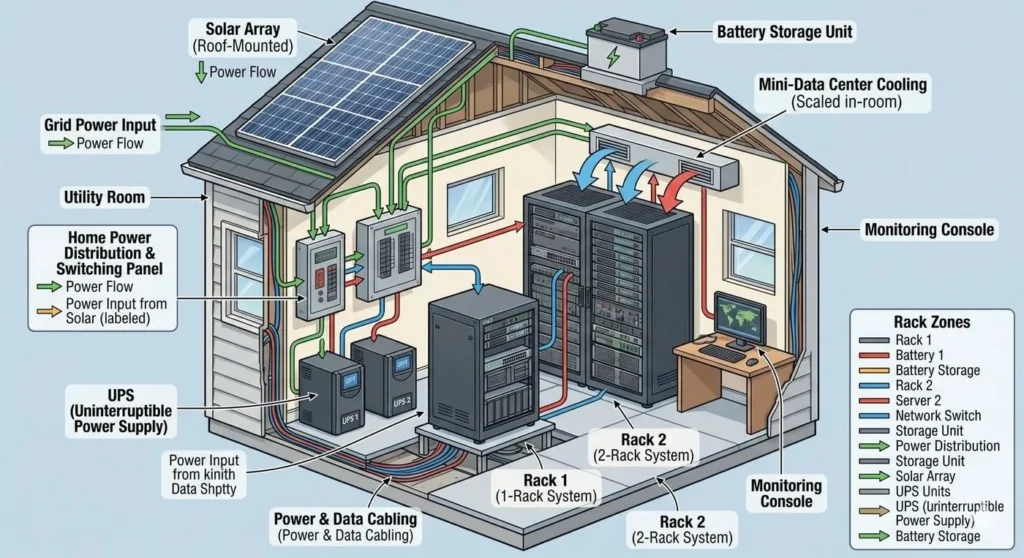
Two racks in a utility room
A dedicated room with roof-mounted solar, battery storage and dual UPS feeding one or two racks. Scaled in-room cooling keeps the hardware in range, and a local console mirrors the SOC view.
- Footprint
- Utility room
- Racks
- 1–2
- Power
- Rooftop solar + grid + battery
- Resilience
- Dual UPS, switching panel
- Cooling
- Scaled in-room cooling
- Monitoring
- Local console + ThiRU SOC
Edge compute at the 5G base station
Racks sit in the tower shelter, sharing the site's power, security and backhaul. Users on the tower get single-hop latency for AI inference, video and apps.
- Footprint
- Tower shelter
- Racks
- 2–4
- Power
- Site power + battery
- Network
- 5G / fibre backhaul
- Latency
- Single hop to subscribers
- Monitoring
- ThiRU SOC
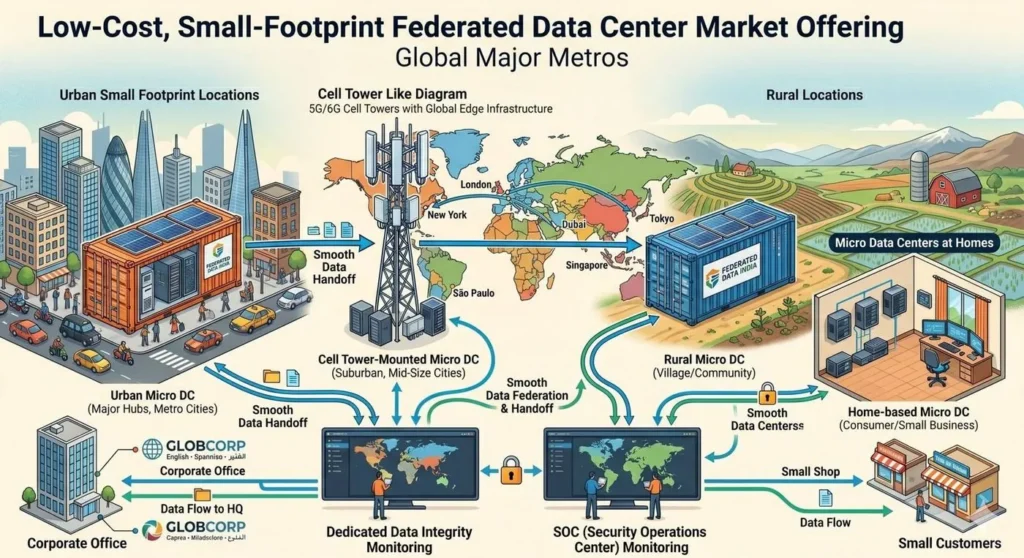
A shipping-container data centre for the city
A solar-roofed container that fits on a car park, rooftop or vacant lot in a metro hub. It anchors the regional federation and hands workloads to tower, rural and home nodes.
- Footprint
- Shipping container
- Racks
- 8–12
- Power
- Rooftop solar + grid
- Role
- Regional federation anchor
- Handoff
- To tower, rural and home nodes
- Monitoring
- Data integrity + ThiRU SOC
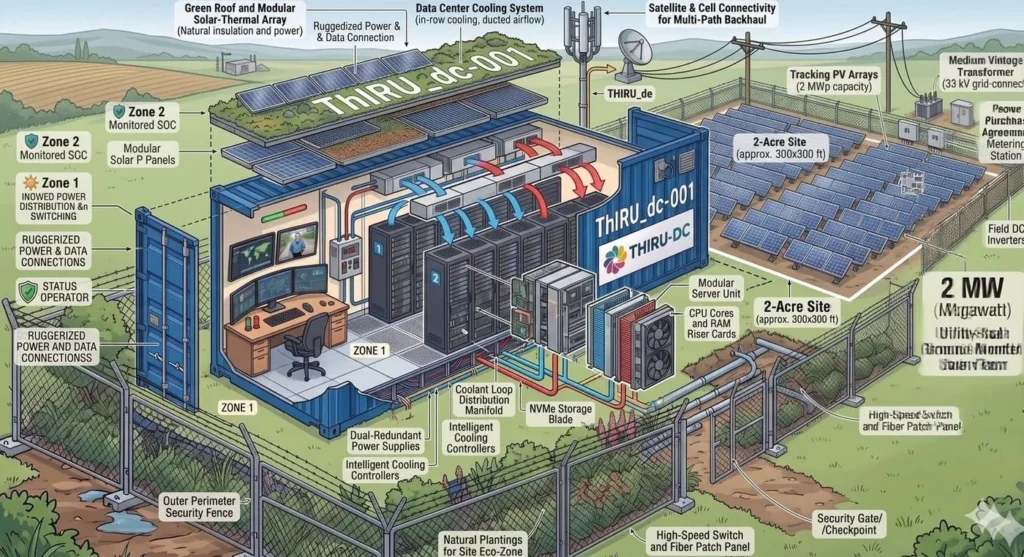
ThiRU_dc-001, the 2 MW solar campus
The flagship rural node: a containerised hall on a fenced 2-acre site with a green roof, a 2 MWp tracking PV field and a 33 kV grid tie. Satellite and cellular links give multi-path backhaul.
- Site
- 2 acres (≈ 300 × 300 ft)
- Solar
- 2 MWp tracking PV arrays
- Grid
- 33 kV medium-voltage transformer
- Power
- Dual-redundant supplies, PPA metering
- Cooling
- In-row, ducted airflow, coolant loop
- Compute
- Modular servers, NVMe storage blades
- Backhaul
- Satellite + cellular, fibre patch panel
- Security
- Perimeter fence, gate checkpoint, zoned SOC
Why federated
Why many small nodes beat one big building
Data sovereignty
Data stays in the country, state or community it belongs to.
Edge latency
Compute sits one hop from users, so AI inference and apps respond in milliseconds.
Solar-first power
Rooftop and ground-mount PV with battery storage, grid as backup.
One SOC
Dedicated data-integrity monitoring plus ThiRU SOC watch every node 24/7.
Capacity is limited per region
Reserve sovereign capacity or host a ThiRU node
Enterprises can reserve racks on the network. Landowners, tower operators, small businesses and households can host a node and earn from the capacity it sells.